Steps one to three happen before the bar moves. If your shoulders hurt on bench, the fix is almost certainly in there.
1
Build your base: feet, hips, shoulder blades
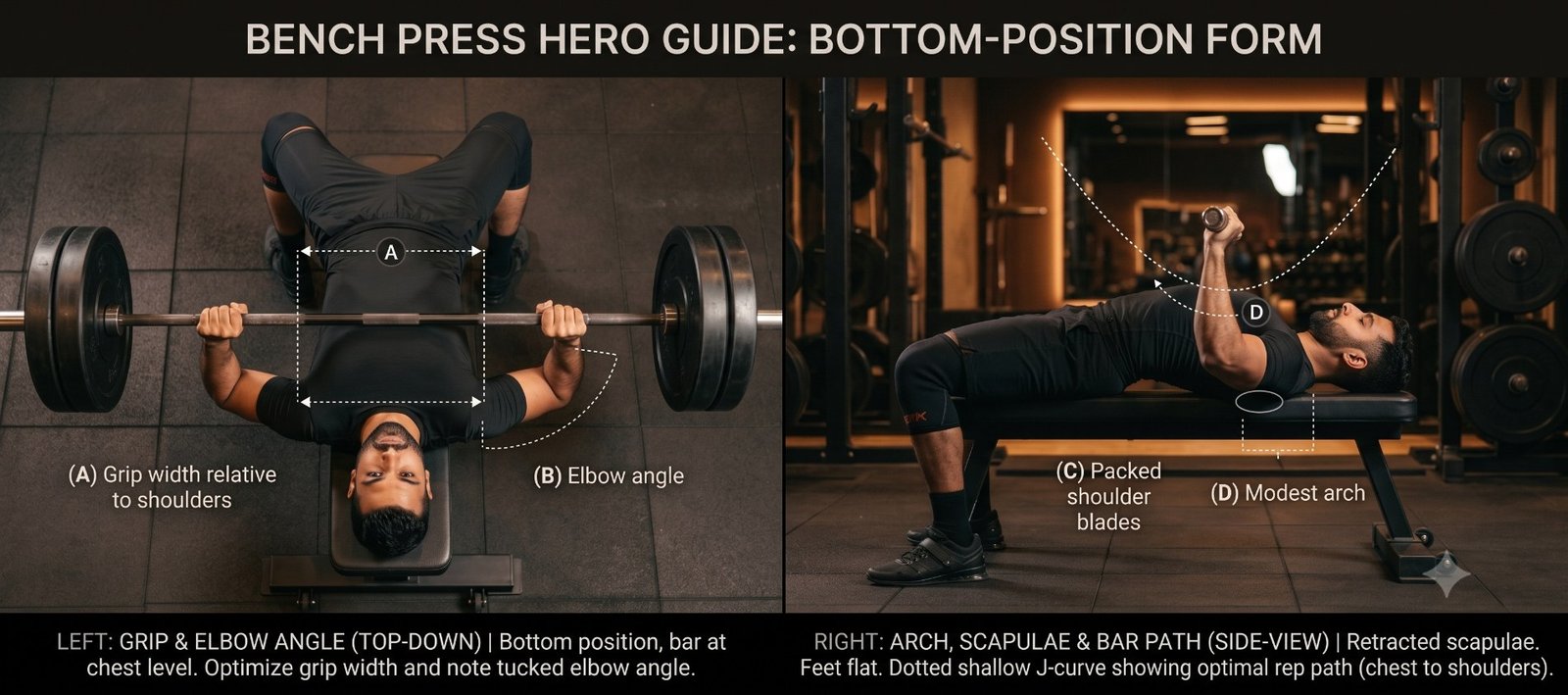
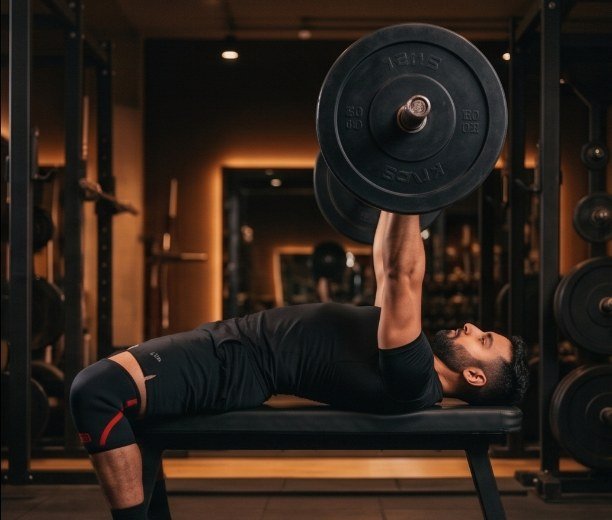
Both feet flat and heavy on the floor, hips on the bench, shoulder blades pulled back and down as if tucking them into your back pockets. A small natural arch through the lower back is correct. This base is what you press against.
►Why this matters: retracted shoulder blades give the shoulder joint a stable shelf to work from. Without it, every rep is pressed off soft tissue instead of a locked platform.
⚠Common mistake: lying flat with the shoulders rolled forward and the feet tucked up on the bench — comfortable, unstable, and hard on the shoulder.
→How we coach it: we set the base as a checklist you run before every set, so it never becomes something you only do when you remember.
2
Set grip width from your forearm angle
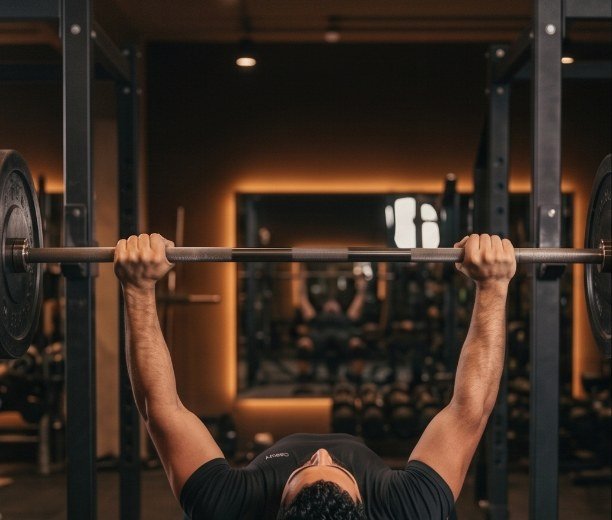
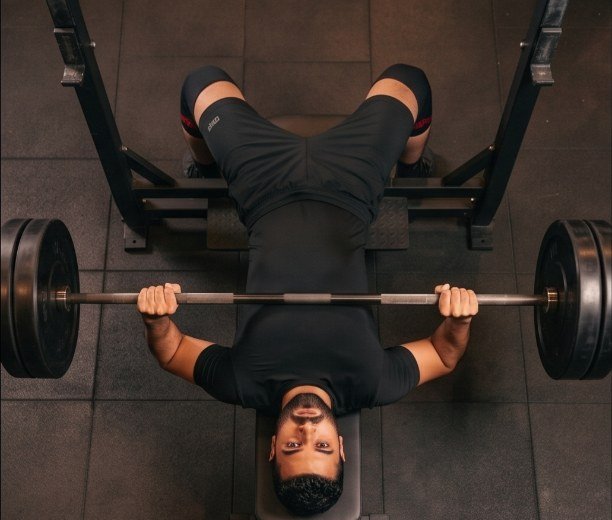
Choose the grip where, at the bottom of the press, your forearms are vertical from a side view and your elbows sit at roughly 45° from your torso. For most people that is slightly wider than shoulder width. Wrists stacked over elbows, not bent back.
►Why this matters: vertical forearms mean force goes straight into the bar. Angled forearms leak force and load the wrist and shoulder instead.
⚠Common mistake: copying a competition-width grip from social media. Grip width is a function of your arm length and torso width, not a number.
→How we coach it: we find your grip from your own forearm angle on video and mark the ring position, so it is repeatable on any bar.
3
Unrack without losing your shoulder blades
Press the bar straight up out of the hooks, then bring it over your chest in one controlled movement — don't pull it out with your shoulders. If the blades come unpacked during the unrack, rerack and reset.
►Why this matters: the unrack is where most setups quietly fall apart. Everything you built in step one can be lost in one second.
⚠Common mistake: reaching for the bar and dragging it out, which rolls the shoulders forward before the first rep even starts.
→How we coach it: we set your rack height and, on heavier work, use a hand-off so your position survives the unrack intact.
4
Lower under control to the sternum
Take two to three seconds down to your lower chest or sternum, elbows tucked around 45–75°, upper back tight against the bench. Touch lightly — no bouncing the bar off the chest.
►Why this matters: a controlled descent is where the strength and the technique are actually built, and where flaring elbows get caught before they cause a problem.
⚠Common mistake: elbows flaring to a full 90° at the bottom, which is the single most common cause of front-of-shoulder pain on bench.
→How we coach it: we film from directly overhead, because elbow flare is nearly impossible to see or feel from where the lifter lies.
5
Press up and slightly back
Drive your feet into the floor and press the bar up and slightly back, so it finishes over your shoulder joint rather than over your chest. The bar path is a shallow J, not a straight vertical line.
►Why this matters: finishing over the shoulder puts the joint in its strongest, most stable position. Pressing straight up leaves the load out in front of it.
⚠Common mistake: pressing straight up and stalling mid-range, or losing leg drive so the hips start to lift off the bench.
→How we coach it: we cue the bar path from the side view and add leg drive only once your base holds without it.
6
Lock out without losing the arch or the blades
Finish with elbows extended, shoulder blades still retracted, hips still on the bench. If your shoulders roll forward at the top or your hips lift, the rep doesn't count — reset your base before the next one.
►Why this matters: letting the blades release at lockout is how a set that started well ends with the last reps pressed from a compromised position.
⚠Common mistake: pushing the shoulders up off the bench at the top to squeeze out extra range — it feels productive and quietly wrecks shoulders.
→How we coach it: we judge the set by the last rep, not the first. If the base breaks at rep eight, the set was six.